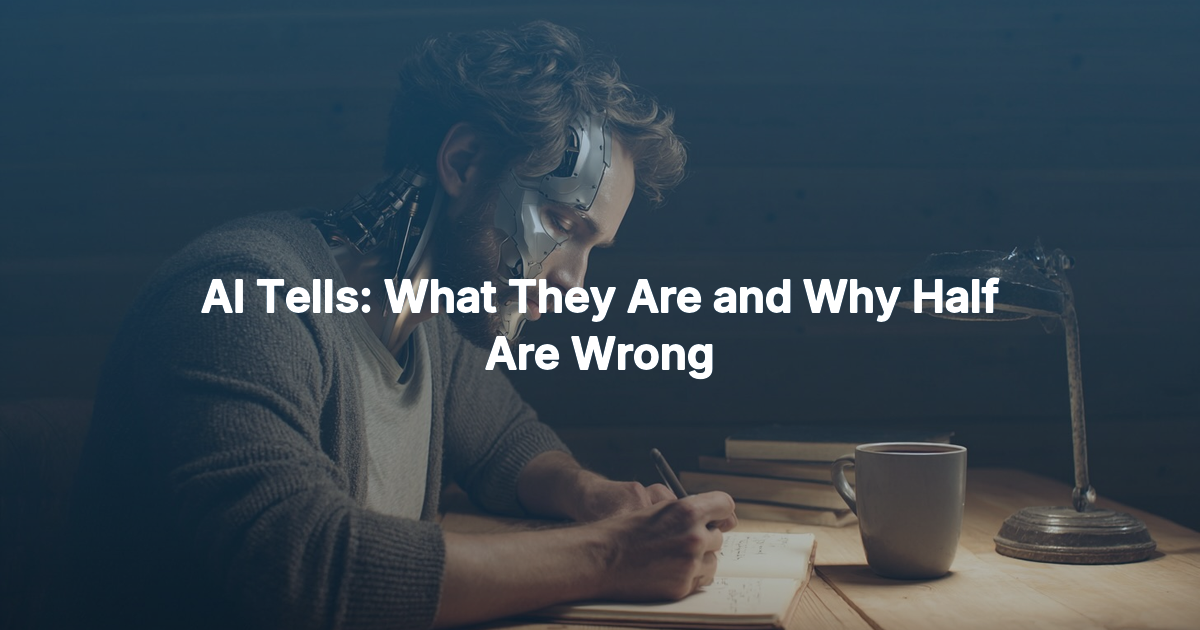
AI Tells: What They Are and Why Half of Them Are Wrong
The internet thinks em dashes prove you're a robot. Here's what actually signals AI writing—and what doesn't.
Earlier this year, a fashion brand posted a short rebrand announcement on social media. Two sentences. Nothing controversial. But the comments section turned into a courtroom. The crime? Two em dashes.
"This is clearly AI," commenters declared. The evidence was right there in the punctuation.
The accusation went viral after LuxeGen, a lifestyle podcast aimed at Gen Z, featured the incident and coined a term that stuck: "the ChatGPT hyphen." Their advice? If you're using AI to write, fine, but at least edit out the dashes. Put it in your own words. Take out the hyphen.
Here's the thing: there was nothing wrong with how that brand used em dashes. Writers have deployed them for centuries. Emily Dickinson used them so heavily that scholars still argue about what she meant by them. Friedrich Nietzsche scattered them throughout his philosophy. Bryan Garner, the famed grammarian, has called the em dash "perhaps the most underused punctuation mark in American writing."
Now it's treated as proof you're a robot.
I have a confession: coming out of college, I didn't even know how to type an em dash on a keyboard. I had no idea there was a shortcut. But over years of editing for academically trained writers, people who went to school specifically to write, I came to appreciate them. The habit rubbed off. I've probably got articles with em dashes in them now.
That's the thing about em dashes. They're a learned skill, passed down through formal writing education and professional editing. People who studied engineering or business or nursing never picked up the habit. They use hyphens. They use commas. And now they're scrolling LinkedIn, spotting em dashes, and assuming the worst.
One Reddit user captured the confusion perfectly: "I'm becoming increasingly suspicious of emails I'm receiving from a particular colleague who I feel is using AI. One thing I notice is that they use em dashes a lot. Typically, I and everyone else I know use standard hyphens. I didn't even know there was a shortcut for an em dash until looking this up."
Another user asked the question that a lot of writers are now wrestling with: "Let's be real, nobody uses them in email or comments. They're uncommon, and keyboards don't even have a key for them. Is this the ultimate ChatGPT tell?"
The answer is no. But the question reveals something important about where we are right now.
AI learned to write by copying trained human writers. It scraped books, articles, academic papers. Meta alone torrented more than 80 terabytes of copyrighted books to train its models. And because professional writers use em dashes, AI uses em dashes. It's mimicry, not invention.
Which creates a strange inversion: trained human writers are now being accused of copying AI.
This is the world we're navigating. A world where certain words, phrases, and punctuation marks have become "AI tells," signals that supposedly reveal whether a piece of writing came from a human or a machine. Some of these tells are legitimate. Others are just good writing that AI happened to copy. And the internet, for the most part, can't tell the difference.
So let's sort through it. What are AI tells, really? Which ones should you actually worry about? And what should you do about them, if anything?
What Are AI Tells?
AI tells are patterns in writing that signal, or appear to signal, that content was generated by AI rather than written by a human.
The concept emerged organically, mostly on Reddit and LinkedIn, as people tried to develop heuristics for spotting machine-generated text. Some observations were genuinely useful. Others were pseudoscience dressed up as pattern recognition.
The problem is that writing has always had patterns. Formal writing uses certain words. Academic writing follows certain structures. Professional copywriting leans on certain phrases. AI was trained on all of it, which means AI reproduces all of it. And now anything that looks "too polished" or "too professional" is suspect.
As Mignon Fogarty, host of the Grammar Girl podcast, puts it: "These words appear in LLM output because they were in the training data, which was written by humans." They're only red flags when they "show up in the writing of people who wouldn't normally use them or in situations where they are out of place."
That's the key distinction. An em dash in a carefully edited blog post from someone with an English degree? Normal. An em dash in a casual Slack message from someone who's never used one before? Maybe suspicious. The tell isn't the punctuation itself. It's the mismatch between the writing and the writer.
But most people don't have that context. They're scrolling feeds, skimming emails, making snap judgments. They see an em dash and think: bot.
ChatGPT itself, when asked about this, acknowledges the problem: em dashes "by themselves are not a reliable sign that a text was AI-generated." The misconception, it says, may be a vestige of earlier, less sophisticated models. "Some early AI-generated content (especially before 2023) used em dashes more frequently than the average human writer. It was part of mimicking formal or stylized writing."
In other words, even the AI knows this particular tell is overblown.
But em dashes are just the beginning. The list of supposed AI tells has grown into a sprawling catalog of words, phrases, punctuation marks, and structural patterns. Some are worth paying attention to. Many aren't. And if you want to write clearly in 2025, you need to know the difference.
The Buckets: Not All Tells Are Created Equal
The internet has compiled a sprawling list of AI tells. Words, phrases, punctuation, structural patterns. But they're not all equally meaningful. Some are legitimate signals. Others are just markers of formal education that AI happened to absorb.
To make sense of it, I've organized them into buckets based on why they get flagged and who they actually affect.
Bucket 1: Punctuation and Formatting
This is the "keyboard literacy" bucket. Things that most people don't know how to type.
Em dashes are the poster child, but they're not alone. Oxford commas, semicolons, and consistent formatting all fall into this category. The accusation is always some version of "nobody uses these in casual writing."
The reality is that formally trained writers have used these for decades. The em dash isn't AI's invention. It's a tool that writers learn in journalism school, English programs, and professional editing environments. One blogger on Wealthy Affiliate captured the dilemma in a comment thread: "I actually use em dashes in my writing. If you are using Word, they are quite easy to make." Another commenter asked the question that haunts a lot of writers right now: "Do you remove the em dashes when you create an AI-assisted article?"
Plagiarism Today actually tested this. They gave the same prompt to six different AI systems and counted the em dashes. ChatGPT, Copilot, and DeepSeek used them heavily. But Claude only had two. Gemini and Meta's AI used zero. The "tell" isn't even consistent across AI models.
The Oxford comma is a slightly different case. It's less about education and more about religion. People have been fighting about Oxford commas since long before ChatGPT existed. If you've always used them, keep using them. If you haven't, don't start now because you think it sounds smarter.
Who this affects: Journalists, English majors, professional editors, and anyone who learned to write in a formal setting. These people are now being penalized for skills they developed intentionally.
Bucket 2: Vocabulary (The Five-Dollar Words)
This bucket is more legitimate. These are words that AI reaches for reflexively, often when simpler options would work better.
The hall of shame, according to research covered in The Conversation: delve, tapestry, landscape, realm, leverage, harness, pivotal, meticulous, robust, multifaceted, underscore, showcase.
Since ChatGPT's release, academic papers have seen measurable surges in words like "delves," "showcasing," "underscores," "pivotal," "realm," and "meticulous." The pattern is clear enough that editors are starting to use these words as screening criteria.
One editor told Forbes something that's become a bit infamous: "I no longer believe there's a way to innocently use the word 'tapestry' in an essay; if the word 'tapestry' appears, it was generated by ChatGPT."
That's probably too strong. But the point stands: these words don't add meaning. They're filler that sounds impressive. AI uses them because it was trained on formal writing that overused them. And now they've become a signal.
The AI Phrase Finder database, which has analyzed over a million AI-generated texts, ranks "delve" and "tapestry" among the most reliable indicators. Not because humans never use them, but because AI uses them constantly and without purpose.
Who this affects: Everyone, but especially people who default to formal vocabulary when they're trying to sound smart. The fix here is simple: use plainer words. "Explore" instead of "delve." "Mix" instead of "tapestry." "Area" instead of "landscape."
Bucket 3: Phrases and Sentence Starters
This is where things start to feel formulaic. These aren't individual words but constructions that AI reaches for over and over.
Introductions:
- "In this article, we'll explore..."
- "In today's digital age..."
- "In the ever-evolving world of..."
- "Let's delve into..."
Transitions:
- "Furthermore," "Moreover," "Additionally"
- "It's important to note that..."
- "That said..."
Conclusions:
- "In conclusion," "In summary"
- "Remember that..."
Emphasis phrases:
- "cannot be overstated"
- "a testament to"
- "plays a crucial role"
- "at the forefront of"
Journey metaphors:
- "Embark on a journey"
- "Navigate the complexities"
- "Unlock the full potential"
The AI Phrase Finder's list of 100 common ChatGPT phrases is worth scanning. You'll recognize most of them. "Master the art of." "A tapestry of." "In the dynamic world of." "A treasure trove of."
These phrases aren't wrong. Many of them existed in business writing and academia long before AI. But AI uses them as defaults, which means they've become associated with lazy, templated writing. Whether a human or a machine wrote them, they make your writing sound generic.
Who this affects: Anyone writing on autopilot. The problem isn't that these phrases are AI tells. The problem is that they're crutches that add no value. Cut them regardless of whether you're worried about AI detection.
Bucket 4: Structural Tells
This bucket is about how writing is organized, not what it says.
AI-generated content tends to have a specific shape: uniform paragraph lengths, predictable structure (intro, three points, conclusion), and a smoothness that comes from never breaking rules for effect. Every section is three to four sentences. Every transition is signaled. Every point is balanced against every other point.
The Ringer nailed it: "The true signature of a ChatGPT response is more abstract and less definite. It's the flat quality, the formulaic sentences, the absence of original ideas."
Human writing has texture. Short sentences. Long ones. Fragments sometimes. Paragraphs that run long because the idea demands it. AI writing is frictionless in a way that feels uncanny once you notice it.
Other structural tells:
- Bullet point addiction (everything becomes a list)
- Perfect grammar with no rule-breaking for voice
- Hedging language everywhere ("It's worth noting," "One might argue")
- No sentence variety
The bullet point thing deserves a closer look. An article that's basically all bullets is a screaming tell, but not for the reason most people think. It usually means someone gave AI a short prompt and ran out of tokens. The model gets 80% through the work and has to throw something together to fill the space. Bullets are cheap. They pad word count without requiring the model to develop ideas.
This is less "AI vs. human" and more "low-effort AI use vs. high-effort anything." Someone on free ChatGPT with a vague two-sentence prompt gets bullet soup. Someone with a detailed prompt, a paid tier, or actual editing skills gets something that reads like prose. The tell isn't the tool. It's the effort.
Who this affects: Everyone using AI without editing, but also anyone who writes formally and forgets to inject personality. The structure itself isn't the problem. The absence of variation is.
Bucket 5: Tone and Voice (The Actual Problem)
This is the bucket that actually matters.
Everything in Buckets 1-4 can be faked, edited around, or explained away. But Bucket 5 is hard to manufacture because it requires something AI doesn't have: lived experience.
AI writing tends to be:
- Relentlessly positive ("exciting," "fascinating," "remarkable")
- Over-empathetic ("This can feel overwhelming," "You're not alone")
- Enthusiastically bland ("Let's dive in!" "So go ahead!")
- Devoid of strong opinions
- Missing humor, sarcasm, or edge
- Free of personal anecdotes
One Wordtune analysis noted a quirk: "ChatGPT loves dance metaphors. Everything is an intricate and delicate dance between x and y."
AI can't tell you about the time it failed at something. It can't reference a specific conversation it had last Tuesday. It can't take a controversial position and defend it with personal stakes. It can only synthesize patterns from text it's seen.
This is why the vocabulary and punctuation debates are mostly noise. The real tell is the absence of a specific human perspective. An em dash from someone with something to say is just punctuation. An em dash from a machine with nothing to say is part of a larger emptiness.
Who this affects: Everyone. But this is also where humans have an unbeatable advantage. AI can mimic your word choices. It can't mimic your experiences.
Bucket 6: The Meta-Tells
This is the saddest bucket. These are signs that someone is trying too hard to not look like AI.
- Deliberate typos to seem human
- Removing ALL em dashes, even when they're appropriate
- Forced casualness after paragraphs of formality
- Unicode tricks to fool detectors
Reddit threads are full of writers describing their strategies for evading AI detection: intentionally misspelling words, alternating British and American spellings, adding random punctuation. One person mentioned making their writing "less perfect" on purpose.
This is the absurd endgame. People performing "not-AI" instead of just writing authentically. Dumbing down their work to avoid suspicion.
If you find yourself in Bucket 6, something has gone wrong.
Why Context Changes Everything
Here's something that gets lost in the AI tells conversation: how your writing is perceived depends entirely on where it appears and how much of you the reader can see.
An em dash in a tweet hits different than an em dash in a 4,000-word article. Same punctuation. Completely different reception.
Short-Form: You're a Stranger
When you post on Twitter or LinkedIn, you're a stranger to most of the people who see it. They don't know your background. They don't know where you went to school or what you do for a living. They see 280 characters and make a snap judgment.
In that context, every word choice carries disproportionate weight. There's nothing else to judge. One em dash stands out because there's no surrounding voice to contextualize it. One "delve" in a tweet feels damning because there's no personality to offset it.
If I'm scrolling social media, I don't know what your major was. I don't know you spent ten years as an editor. I don't know that you've used em dashes since college. I just see the dash and think: huh, that looks like ChatGPT.
This isn't fair, but it's how short-form content works. The reader has no baseline for who you are. Every signal gets amplified because there are so few signals to work with.
Long-Form: Your Voice Accumulates
A 4,000-word article is different. By paragraph three, the reader has started to build a mental model of who you are. They've seen how you construct sentences. They've noticed your rhythm. They've picked up on whether you have opinions or just summarize other people's opinions.
In that context, an em dash in paragraph twelve is just punctuation. It's one data point among hundreds. The reader isn't scrutinizing your semicolons because they're too busy following your argument.
Long-form content gives your voice room to emerge. Quirks become personality instead of red flags. The em dash stops looking like a tell and starts looking like a choice.
This is why accusations of AI use cluster around short-form content. It's not that AI is better at writing tweets. It's that tweets don't give you enough space to prove you're human.
The Mismatch Problem
The real issue is when writing style doesn't match the venue.
Formal punctuation in a casual Slack message looks weird regardless of whether AI wrote it. An em dash in "hey, can you send me that file" raises eyebrows not because of AI but because it's stylistically out of place.
Similarly, overly casual writing in a formal report looks off. "So yeah, the quarterly numbers are pretty solid" doesn't belong in a board presentation, whether a human or a machine wrote it.
AI tends to flatten everything into the same register. It defaults to "professional" in a way that often feels mismatched to the context. A human writer adjusts tone instinctively. AI needs to be told.
This is another reason the tells conversation misses the point. The problem isn't em dashes. The problem is writing that doesn't fit its context. A human who learned em dashes in journalism school knows when to use them and when to leave them out. AI uses them everywhere unless you specifically instruct it not to.
What Should You Do About It
So you've read through the buckets. You've thought about context. Now what?
Here's a framework for thinking it through, rather than a set of paranoid rules.
Step 1: Know Which Bucket You're Dealing With
Not all tells deserve the same response.
Punctuation tells (Bucket 1) are mostly noise. If you've always used em dashes, you don't need to stop. If you've never used them, don't start. The accusations say more about the accuser's reading habits than your writing.
Vocabulary tells (Bucket 2-3) are worth addressing, but not because of AI detection. Words like "delve" and "tapestry" and phrases like "in today's digital age" don't add meaning. They're filler. Cut them because they make your writing worse, not because someone might think you're a bot.
Voice tells (Bucket 5) are the only ones that really matter. If your writing lacks perspective, opinion, and specificity, that's a problem regardless of what anyone thinks about AI. The fix isn't cosmetic. It's substantive.
Step 2: Consider the Venue
Context determines how your choices get read.
Long-form content (blog posts, articles, reports) gives your voice room to breathe. If you've always used em dashes in your writing, keep using them. Your perspective will emerge over paragraphs, and quirks will read as style rather than tells. Nobody's counting your dashes when they're busy following your argument.
Short-form content (tweets, LinkedIn posts, cold emails) puts every word under a microscope. There's no room for your voice to accumulate. In these contexts, lean toward simpler punctuation and plainer vocabulary. Not because em dashes are wrong, but because they stand out more when there's less surrounding context to justify them.
Emails to strangers fall somewhere in between. A cold outreach email is essentially short-form. A long email to a colleague who knows your writing style is closer to long-form. Adjust accordingly.
The principle is simple: the less context the reader has for who you are, the more your style choices get scrutinized.
Step 3: Scrub the Stuff That Adds Nothing
Some vocabulary and phrases are worth removing everywhere, not because they're AI tells but because they're dead weight.
"Delve into" can become "explore" or "look at." "In today's digital landscape" can usually be cut entirely. "It's important to note that" is almost always filler before something you were going to say anyway.
This isn't about hiding AI use. It's about writing clearly. If a phrase doesn't add meaning, it's taking up space. Cut it whether you're worried about detection or not.
Step 4: Focus on What Actually Matters
The real fix isn't playing defense against the punctuation police. It's injecting the things AI can't fake.
Opinions. Take a position. Defend it. AI hedges because it's trained to be neutral. You don't have to be.
Anecdotes. Reference something that actually happened to you. AI can't do this because it hasn't experienced anything.
Specificity. Name names. Cite numbers. Mention the exact situation you're describing rather than gesturing at generalities.
Edges. Be willing to say something that not everyone will agree with. AI smooths everything into consensus. Rough edges are a sign of life.
The question to ask yourself: "Does this sound like a specific person, or does it sound like 'professional writer'?" If the answer is the latter, the problem isn't your punctuation.
A Note on Venue-Shifting
If you're repurposing content across formats, keep the venue difference in mind.
A blog post that uses em dashes naturally might need those dashes removed when you pull a quote for Twitter. Not because the dashes were wrong in the original, but because they land differently in 280 characters.
This is annoying, but it's the reality. The same sentence reads differently depending on where it appears. A formally trained writer knows this instinctively for tone and vocabulary. Now punctuation has joined the list.
Conclusion
The em dash isn't the problem. The Oxford comma isn't the problem. "Delve" is a little bit of a problem, but mostly because it's a lazy word, not because it proves you're a robot.
The real issue is writing that sounds like it could have come from anyone or anything. Generic. Frictionless. Devoid of a specific human perspective.
AI learned to write by copying trained human writers. It absorbed their vocabulary, their punctuation, their structures. Now trained human writers are being accused of copying AI. The irony isn't lost on anyone who's been using em dashes since before ChatGPT existed.
But here's the thing: if your voice is strong enough, nobody's counting your dashes. They're too busy engaging with your ideas.
The tells that matter aren't punctuation or vocabulary. They're the absence of lived experience, genuine opinion, and specific detail. Those are things AI can't fake, no matter how many terabytes of books it ingests.
So write like yourself. Use the punctuation you've always used. Say what you actually think. And if someone accuses you of being a bot because you know how to use a semicolon, take it as a compliment.
They're just telling on their own reading habits.
Sources and Further Reading
- Inside the unofficial movement to save the em dash — from A.I. — NPR
- Are Em Dashes Really a Sign of AI Writing? — Rolling Stone
- ChatGPT is changing the way we write. Here's how — and why it's a problem — The Conversation
- Stop AI-Shaming Our Precious, Kindly Em Dashes—Please — The Ringer
- Are em dashes really a telltale sign of AI writing? — Night Water Newsletter
- Em Dashes, Hyphens and Spotting AI Writing — Plagiarism Today
- 100 Common ChatGPT Phrases — AI Phrase Finder
- Introducing Steadily: The AI Agent That Solves the Authenticity Paradox — Steadily
- Why Smart Businesses Are Building on Bluesky — Steadily